
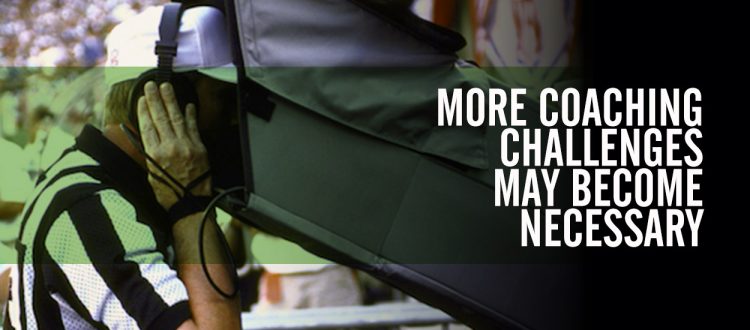


For the good of the gaming and fairness in gambling, coaches should be able to challenge game-changing penalties
One couldn’t help but watch the NFL playoffs this year and be upset by penalty calls or obvious missed penalty calls that affected the game. In the past the league would have simply swept bad calls under the rug and said oops, it was a judgement call, but things have changed. With social media, fans are constantly posting stills from the game that showed instances where a clear pass interference that wasn’t called, where a face mask was missed, or where a horse collar tackle was called but it was evident that wasn’t he case. And for every instance like that there are fans questioning whether the call or missed call was made intentionally.
In the 2018 NFC Championship game Nikkell Robey-Coleman of the L.A. Rams hit New Orleans Saints wide receiver Tommy Lee Lewis well before the ball got near him and no call was made. NFL Senior VP of Officiating Al Riveron admitted after the game that the officials messed up.  This blatant missed call and cries from fans and teams led the league to allow teams to challenge pass interference calls for the 2019 season. That experiment went nowhere as only 13 of 81 challenges were upheld and league officials often angrily headed under the hood to review the play, making it clear that judgement calls should not be challengeable. Coaches were also upset because they said more times than not officials would go under the hood look for 2 seconds and uphold the call on the field without even giving it serious consideration. It was clear that that this was a hill the NFL referees were set to die on. Owners obviously didn’t want to upset the officials, so they agreed not to continue with pass interference challenges and it was never really even noticed in 2020, probably because of the covid crisis and no fans in the stadiums.
It may have seemed like a dead issue but many games in years since have had questionable calls and this year a slew of bad calls has brought the issue to the forefront again.
The AFC divisional matchup in particular, where the Denver Broncos won 33-30 over the Buffalo Bills, had fans, analysts and bettors riled. Riley Moss of the Denver Broncos clearly interfered with Brandon Cooks with 41 seconds left but no pass interference call was made and later two very controversial pass interference calls were made against the Bills, effectively handing the win to the Broncos. Not surprisingly, there were immediate accusations by Bills fans, as well as gamblers who bet on the game, accusing officials and the league of being biased since in their view the league wanted the Broncos to win the game for better ratings (although obviously the league said that is ridiculous). Yet this could have simply been avoided if those calls could have been reviewed independently.
So it brings up the question once again whether pass interference, or any major penalty should be open to challenge again in the NFL? And if the league does allow challenges, how can it be implemented so that the video evidence is the only thing relevant and any referee bias is taken out of the equation?
How do other leagues handle coaches challenges
I decided to look at challenges on penalty calls in other leagues and this is how they are handled:
NBA: Each team is given one coaching challenge, but get a second challenge is awarded if the first is successful. Challenges can be used for the following:
- Personal fouls on the team can be challenged anytime during the game
- Out of Bounds can be challenged with more than 2 minutes left in regulation or in the first three minutes of overtime
- Goaltending can be challenged with more than 2 minutes left in regulation or in the first three minutes of overtime
With under 2 minutes left, only officials can ask for a review of a questionable play and it’s usually only used when there is disagreement among officials. Baskets that are scored when the clock goes to zero are always reviewed to make sure the player got the shot off in time.
The penalty for unsuccessful challenges is that the team loses a timeout.
NHL: There is no limit to coaching challenges in the NHL, but an unsuccessful first challenge results in a 2-minute delay of game penalty and a subsequent missed challenge is a 4-minute penalty. Consequently, coaches usually only challenge if they are certain of the call or if it is very late in the game and the infraction could have a major impact on the outcome. Challenges can be used for the following:
-
- Offsides – note if the play is deemed offside then the game clock moves all the way back to the time of the offsides which could add many minutes to the game
- Hand pass
- Goalie interference
- Missed stoppages in play by the referee where a goal was scored but would not have been had the play been stopped as required
Note that the challenge rule was initiated as a result of missed calls that affected prior games.
MLS: Each team is given two coaching challenges that are reviewed by the video review system (VAR). Challenges can be used for the following:
-
- Offside calls
- Possible fouls that led to a goal
- Penalties in the box that would result in a penalty kick
- Red Cards where a player would be ejected from the game (teams can ask for a review to see if a player’s foul was egregious enough to warrant the card)
- Mistaken player, i.e. the coach can argue that the card was given to the wrong player
Note that near the end of regulation or during overtime the review booth can ask for play to be stopped so they can initiate a VAR review.
MLS is unique since the VAR system is completely independent of the on-field referees so only the league can determine if a challenge is successful.
MLB: Coaches get 2 challenges a game although challenges are maintained if a challenge is successful. Challenges can be used for the following:
-
- Baserunning calls (safe or not safe, pickoff successful or not, missed the base or not etc.)
- Home run or not (although umpires usually check automatically without use of a challenge)
- Fielding calls (catch or no catch)
- Catcher interference
- Hit by a pitch or not
- Balls and strikes (coming in 2026)
For the latter (known as robo umps), only the pitcher, catcher or batter can challenge a ball or strike call and the result will be what the ABS system deems, hence taking the decision completely out of the hands of ump.
NFL: Coaches get 2 challenges per game and an extra challenge if one of the challenges is successful. Challenges can be used for the following:
-
- Pass complete or incomplete
- Fumble or no fumble and Interception or no interception (although turnovers are automatically reviewed by the league)
- Catch made inbound or out of bounds
- Touchdown or no touchdown (although the review is done automatically if a player scores a TD)
- Line to gain is made or not
- Too many players on the field
- Illegal forward pass or lateral
It’s easy to see the major difference between the NFL and other leagues is that penalty calls are not reviewable in the NFL but are reviewable in the other leagues. For instance, goalie or catcher interference can be reviewed in the NHL and MLB and MLS makes pretty much everything challengeable and quickly reviewed by VAR. And in the NBA fouls are looked at very closely and the number of overturned foul calls is quite high.  Unlike the NFL where only the head referee makes the call, in the NBA, all on court officials look at the replay and make a decision using majority rules and inside of two minutes, the NBA Referee Center gets involved. In the NFL the head official has almost full autonomy for the first 2 minutes of each half unlike the other professional leagues, and the NFL officiating booth in New York only gets involved for calls inside of 2 minutes left.
The question that has to be asked is why the NFL is so much more sensitive than other leagues on judgement calls and more importantly whether it’s more vital to protect the official’s feelings or to get the call right? The answer seems obvious to most, not only because it’s important that a team does not lose a game due to a bad call, but also because the league is heavily intertwined with gambling companies and like it or not, it’s imperative that the league do everything they can to ensure that individuals betting on their league, as well as sportsbooks, are protected.
As an added benefit it would ensure that bad apples can’t easily rig games. This isn’t to suggest that NFL referees are doing anything wrong including purposely making bad calls, but it can’t be overlooked that at many times in history that was an issue, including when Ted Donaghy was charged with helping fix NBA games, so it’s important to ensure that even the notion of cheating is removed. And sensitivities should not be a reason not to allow additional challenges. Even in MLB where umpires threatened to go on strike over robo umps, they are now willing to accept the technology.
Suggestions for some changes
So, given the way things work in other leagues this is what I believe would be a good challenge system for the NFL.
1 – Allow challenges as they exist now, but also allow one additional challenge a -for a penalty call. If that challenge is upheld, then allow a second. But if it’s denied then the coach can no longer challenge a penalty (perhaps a different color flag than red can be used for that type of challenge).
2 – The only penalties that can be challenged are those of 15 yards or more meaning pass interference, face mask, unnecessary roughness, targeting, roughing the kicker (instead of running into), horse collar or similar. Holding calls, offsides and penalties 10 yards or less can’t be challenged.
3 – Challenges for penalties should only be reviewed by the league in New York. Doing so, takes away the inherent bias of referees who have proven they will rarely if ever overturn a judgement call.
4- Charge a 5-yard delay of game penalty on an unsuccessful penalty challenge for the offensive team or a 5-yard penalty and automatic first down if the defensive team unsuccessfully challenges a penalty call. This will ensure that teams only challenge calls they feel relatively sure are warranted.
5 – Within 2 minutes left in the game the booth should be allowed to review any penalty, as well as the calls they review now. So, if the booth feels there may have been a missed pass interference or face mask they can ask the referees to halt the game and the booth along with all referees on the field should be able to review the play and decide if the penalty is warranted or not, with the majority making the call.
Will these add a bit of time to games? Sure. Will it hurt some referee’s feelings? Probably. But again, what it does ensure is that a game isn’t decided by a bad call or missed call. The NFL has initiated several rules it first opposed in recent years including the rule last year that allows both teams to possess the ball in OT whether a touchdown is scored by the first team or not. So. this would just be another way for the league to say that they only want to do what is best and fair for the teams and fans (and bettors although they will never admit that publicly). It’s about time the change is made and it will make the league better for all.
Read articles on sports betting and the North American gambling industry from Hartley Henderson here at GamblersWORLD.








 About Us
 T&C
T&C Privacy
 Contact
 Buy Picks